Baby sleepwear · Practical guide
Choosing a Coyuchi Snuggle Sack: Fabric, Fit, and Everyday Care
A wearable sleep layer can offer warmth without placing a loose blanket in a baby’s sleep space. Coyuchi’s snuggle sacks pair organic cotton with details intended for everyday dressing and changing. The right choice depends less on appearance than on how the fabric feels, how the garment fits, how it opens, and whether its care routine works for your household.
Published November 14, 2026
A simple layer, with important details
In the quiet hours of a newborn’s first months, ordinary tasks take on a new rhythm. A diaper change may happen under a dim lamp; a clean sleep layer may be needed before the next feeding; laundry can accumulate faster than expected. A snuggle sack is designed for this kind of routine: it is wearable bedding, usually shaped like a small sleeping bag, so a baby can be dressed in a warm layer rather than covered with a loose blanket.
The term “snuggle sack” is often used for wearable sleep garments, but products vary. Some have arm openings and a front zipper, while others are knitted and close with buttons. They may also differ in fabric weight, cut, and size range. Those differences affect comfort and convenience, but a garment’s name or natural-fiber content does not, by itself, establish that it is suitable for every baby or every sleep environment.
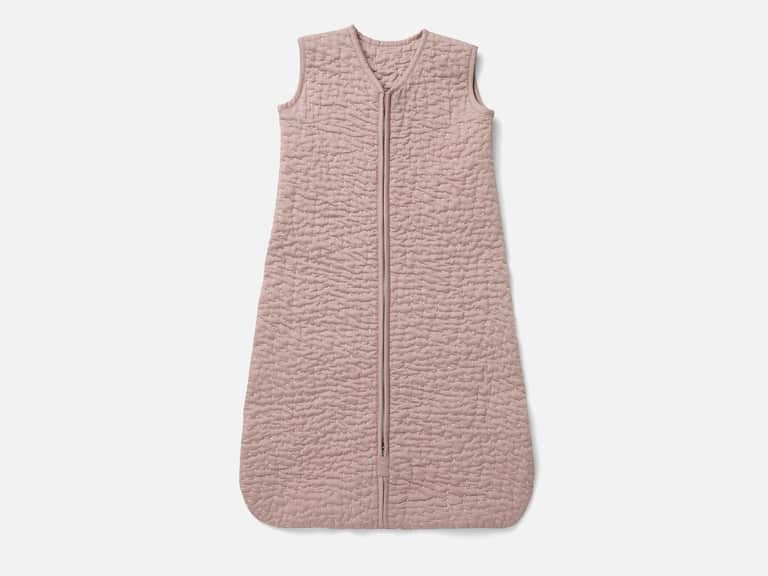
Coyuchi’s Pebbled Handstitched Organic Snuggle Sack is described as made from certified organic cotton sateen, with handstitched texture and a covered front zipper. The design has arm openings, and the product information describes it as a warm layer intended to avoid loose blankets. Before choosing any sleepwear, check the current product listing and sewn-in label for its available sizes, measurements, intended use, and care instructions. Details can vary by style or season.
Sateen and knit: two different experiences
Fabric is the first point of comparison because it determines how a garment feels against skin and how it behaves through wear and washing. Coyuchi’s Pebbled Handstitched style uses organic cotton sateen. Sateen is a woven fabric with a smooth surface and a gentle sheen; in this sack, the handstitched detailing adds raised texture. The effect is a soft, relatively polished feel rather than the visibly looped surface of a knit.
A cotton knit, by contrast, is made with interlocking loops. Depending on its construction, it may feel more flexible or T-shirt-like, with a little give as a baby moves. That can make a knit garment feel different when dressing a wiggly infant or lifting the arms through openings. The exact hand and stretch depend on the particular fabric and pattern, so it is sensible to look at the current garment description rather than assume all organic cotton knits behave alike.
Neither fabric is automatically the best choice. Consider the baby’s usual room conditions, the clothing worn underneath, and the family’s preference for a smooth or knitted texture. A warmer-feeling fabric may be comfortable in a cool room but too much in a warm one when combined with heavy pajamas. A lightweight-feeling fabric may suit a different set of conditions. The goal is not to add as many layers as possible; it is to dress the baby appropriately for the environment and avoid overheating.
“Organic” describes how the cotton is certified or produced according to a particular standard; it does not replace attention to garment fit, temperature, or safe-sleep practice. Coyuchi identifies the Pebbled Handstitched sack as GOTS certified and Fair Trade Factory Certified. Families who value those attributes can review the product’s certification information alongside the practical features that matter at bedtime.
For a closer look at the style, see the Pebbled Handstitched Organic Snuggle Sack. Its listed construction includes organic cotton sateen, arm openings, handstitched texture, and a covered front zipper. Read the live listing and garment label for the current version’s specifications.
Fit: room to move, without excess fabric
Fit is a safety and comfort consideration, not merely a matter of how long a garment may last. A sleep sack should be selected for the baby’s present size, following the maker’s sizing guidance. A roomy-looking garment is not necessarily a more comfortable or safer one: excess fabric can bunch, while a garment that is too small may restrict movement or pull uncomfortably across the shoulders and torso.
When comparing sizes, start with the baby’s measurements and the manufacturer’s size chart, if provided. Age ranges are only a guide; babies of the same age can differ in length and build. Check that the neck opening cannot ride up over the face, that the arm openings sit comfortably, and that the garment does not strain when the baby moves. The lower portion should allow the movement intended by the design, without creating a pocket of excess material around the face.
Do not choose a larger size simply to extend use, and do not rely on rolling, pinning, or altering a garment to make it fit. If a product’s chart is unclear, ask the retailer or manufacturer for current measurements before purchasing. Replace a sack when the child outgrows it, its closures or seams are damaged, or it no longer sits as intended.
Sleep sacks and swaddles are not interchangeable. A sack with arm openings allows the arms to remain free; a swaddle is designed to wrap or restrict the arms and has different considerations. If a baby is swaddled, families should follow current pediatric guidance and stop swaddling as soon as the baby shows signs of attempting to roll. A wearable sack should not be used to restrain a baby’s movement.
Closures and changing-room practicality
Small construction choices can make a noticeable difference during a nighttime change. The Pebbled Handstitched sack uses a covered front zipper and arm openings. A front opening can make it easier to put on or remove a garment, while a covered zipper helps separate the fastening from direct contact with the baby’s skin. Before each use, check that the zipper moves smoothly, the fabric guard lies correctly, and no loose threads or damaged parts are present.
Other sack designs may use a button placket, a bottom opening, or a different zipper arrangement. A bottom opening can help with diaper access without removing the entire garment, while a full front opening may be helpful when dressing a baby who is already settled. These are practical differences rather than universal advantages: caregivers may prefer one arrangement, and the baby’s age, mobility, and changing routine can affect what feels easiest.
Whatever the closure, take a moment to make sure the garment is fastened as designed and that no part is pressing into the baby. Do not leave a zipper partly open if the manufacturer does not intend the garment to be worn that way. If a closure becomes difficult to operate or the surrounding fabric tears, stop using the sack until it is repaired according to the maker’s guidance or replaced.
Safe sleep remains the foundation
A wearable blanket can help families avoid placing a loose blanket in the sleep space, but it is only one part of safer sleep practice. Follow current guidance from your pediatric clinician and relevant public health authorities. In general, put babies down on their backs for sleep, on a firm, flat, level surface designed for infant sleep, with only a fitted sheet. Keep loose bedding, pillows, stuffed toys, and other soft objects out of the sleep area.
Use sleepwear appropriate to the room and the baby, and take care not to overheat. A sleep sack is not a reason to add extra blankets, and it should not be combined with another wearable layer unless the manufacturer and appropriate health guidance support that use. Avoid products that add weight or compress a baby’s chest, and do not use a sack that is damaged, modified, or too small.
Some products use words such as “breathable” or “safe” in their descriptions. Such claims do not replace established safe-sleep recommendations or guarantee protection from harm. A wearable garment cannot eliminate sleep-related risks. If a baby has a health condition, was born prematurely, or needs individualized advice about temperature or clothing, ask a pediatric health professional for guidance tailored to that child.
Parents and caregivers seeking help with supplies can also ask a pediatric clinic, community health worker, or local family-support organization about available resources. Access to practical, clear information should be part of caring for families, whether the question concerns sleepwear, diapers, or everyday infant care.
Care that fits real laundry routines
Baby sleepwear is likely to be washed often. A beautiful fabric is most useful when its care instructions are manageable and the garment can be kept clean without complicated routines. Product information for the Pebbled Handstitched Organic Snuggle Sack recommends machine washing cold on a gentle cycle and tumble drying low; it also notes that a warm iron may be used if desired. Always confirm instructions on the current label, since that label is the best reference for the item in hand.
Before washing, close the zipper as directed and check pockets or folds for small items. Wash with similar colors and use a mild detergent if that suits your household’s needs. Avoid bleach unless the manufacturer explicitly permits it. High heat can affect cotton fabric, stitching, and elastic or other components, so follow the specified drying temperature rather than assuming that hotter is more hygienic.
After laundering, inspect the seams, zipper, arm openings, and handstitched areas. Look for loose threads, holes, or a zipper that catches. Dry the garment fully before storing or using it, and do not use a damaged sleep sack. If stains remain, follow the maker’s care guidance; aggressive spot treatments can alter color or fabric, even when the base material is cotton.
Buying a second sack can help when one is in the wash, but it is not essential for every family. A small rotation can be convenient for households that experience frequent leaks or spit-up; others may prefer to keep one garment and wash it as needed. The practical choice depends on the baby’s routine, laundry access, budget, and the garment’s drying time.
A thoughtful comparison checklist
When comparing Coyuchi snuggle sack options, it helps to look beyond a product name or a single material claim. A quick checklist can keep the decision grounded in everyday needs:
- Fabric: Decide whether a smooth sateen or a knitted texture better suits your preferences and the conditions in which the baby sleeps.
- Fit: Use the current size chart and the baby’s measurements; avoid sizing up for future growth.
- Movement: Check that arm openings and the body shape allow comfortable movement and are not restrictive.
- Closure: Consider whether a covered zipper, front opening, or another design best fits your changing routine.
- Care: Confirm wash and drying instructions, and decide whether they work with your laundry habits.
- Conditions: Think about room temperature and clothing underneath; avoid layering by habit.
- Condition: Inspect the garment regularly and stop using it if it no longer fits or has damaged seams or closures.
It is also worth checking the product listing shortly before purchase. Fabric descriptions, colorways, size availability, and care details can change. If a crucial measurement or instruction is missing, contact the retailer rather than relying on assumptions drawn from another version of the style.
Choosing for the household, not the photograph
Soft textiles and careful stitching can make a baby’s everyday things feel special, but the most useful sleepwear is the piece that fits correctly, suits the room, and can be cared for consistently. For one family, that may mean preferring sateen’s smooth hand and a covered zipper. Another may value the stretch and feel of a knit style. Neither choice needs to become a test of good parenting; practical circumstances and individual preference matter.
Think through the routine from the first dressing to the next wash. Will the closure be manageable in low light? Does the size guidance clearly match the baby’s measurements? Can the sack be washed and dried according to its label? Does the layer make sense for the room and the pajamas underneath? These questions reveal more than a broad promise of comfort can.
A Coyuchi snuggle sack can be considered as one part of a carefully prepared sleep routine: a correctly sized wearable layer, a clear space, a firm and flat sleep surface, and caregivers following current pediatric advice. Choosing thoughtfully means respecting both the details of the garment and the limits of what any single product can do.